
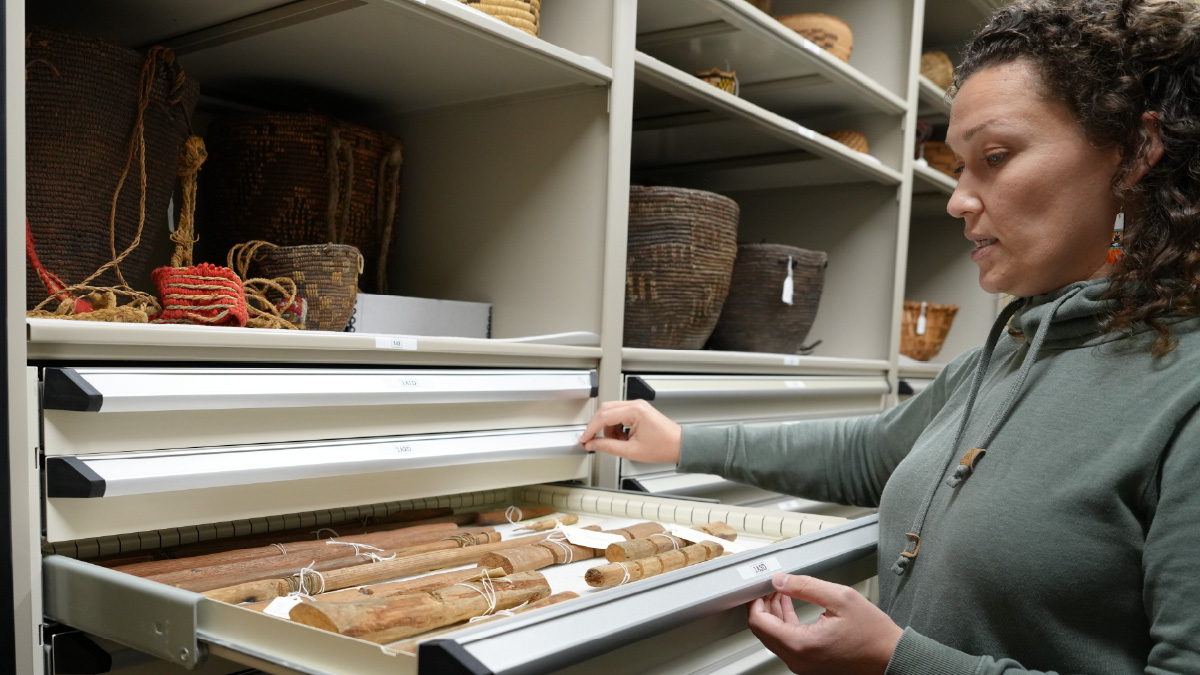
New Collections and Exhibits Manager Kristine Leier is preserving the Tribe’s past while looking toward the future
We sat down with Kristine Leier, Muckleshoot’s new Collections and Exhibits Manager, to talk about the stories held in the Tribe’s collections and the work of preserving them.
Inside the Muckleshoot Indian Tribe’s collections, one basket tells a story of family, care, and huckleberry picking.
The basket was made by Amy Kimball Starr and given to her great granddaughter, Georgiana Starr, who was born in 1940.
According to Leier, it originally held materials to help care for the new baby. The basket stayed in the family and was later used for huckleberry picking at Potato Hill.
Eventually, it made its way back to the Tribe.
“I’m always drawn to objects with stories,” Leier said. “Especially if you know who made an item or the purpose behind it, the intention.”
Now, Leier is preparing the basket for a new exhibit in the Philip Starr Building, where it will be displayed alongside a photograph of Amy and another of Georgiana holding the basket with her father.
For Leier, Muckleshoot’s new Collections and Exhibits Manager, having those details makes all the difference. An object can tell part of the story, but knowing who made it, who used it, and where it has been gives it life.
And there are plenty of stories waiting to be told.
Tucked inside the Philip Starr Building is a collection that many Muckleshoot members and employees may not realize is there, or that they can request to see.
Baskets line shelves inside the environmentally controlled collections room. Drawers hold stick game pieces, fishing tools, carvings, and other cultural materials. Nearby, archival boxes contain photographs, documents, maps, newspapers, and other records. There are oral histories, cassette tapes, digital media, rare books, Tribal publications, and archaeological collections.
Some items have extensive histories attached to them. Others still leave questions.
Learning those stories is part of what Leier loves about the work.
Leier was born and raised in Walla Walla, Washington, and grew up with history already around her.
Her father worked as an archaeologist for the U.S. Army Corps of Engineers in Walla Walla, and family vacations frequently included stops at National Park Service sites.
“I think that sparked my interest in history from a young age,” Leier said.
Still, like many people trying to figure out what they want to do with their lives, she didn’t immediately know what that interest would become.
At Washington State University, mentors helped her begin connecting the pieces. One was Mary Collins, who Leier said had previously worked with her father and was director of the Museum of Anthropology.
At the same time, Leier spent her summers working as an interpretive ranger at Whitman Mission National Historic Site in Walla Walla, where she had opportunities to work with the museum collection.
“I think those two experiences kind of helped me figure out, like, ‘Oh, this is a path I want to pursue,’” she said.
Leier earned her undergraduate degree from WSU before completing a master’s degree in museum studies at Arizona State University.
Her first job after graduate school was as museum curator at Nez Perce National Historical Park, where she would spend the next nine years.
The position gave her extensive experience caring for collections, developing exhibits, working with Tribal communities, and understanding the responsibility that comes with caring for cultural materials belonging to a culture other than her own.
“I’m not Native American,” Leier said. “So for me, it was just really nice to work with others in the community there” and learn how to appropriately care for items and understand the considerations surrounding them.
After nearly a decade in Lewiston, Leier and her husband were ready for a change.
They had talked for several years about eventually moving to Western Washington. Leier has two brothers, one in Renton and one in Port Orchard, as well as extended family in the region. With two young sons of her own, being closer to family became even more important.
Then she saw the Muckleshoot position.
“I read the job description. I was like, this is really very similar to the work I’m already doing,” Leier said.
She had never seen the Tribe’s collection before accepting the position.
That meant arriving at Muckleshoot also meant discovering what was here.
After years working with Plateau material culture, Leier is now immersing herself in Coast Salish collections and Muckleshoot history.
“I always really like coming into a new collection or working with new collections,” she said. “Kind of like, what new things can I bring to the table here?”
Leier started in May and quickly found there was plenty to do.
As Collections and Exhibits Manager, she is responsible for far more than the artifacts people may see in display cases.
The Tribe’s collections include archives, photographs, paper documents, manuscripts, maps, digital media, oral histories, videos, library materials, objects, and archaeological collections.
“I think people realize we have the objects,” Leier said. “I don’t think people often realize archives is part of that.”
The archaeology collection is another large part of the program. The Tribe is an official repository, and archaeological materials make up a significant portion of what is cared for by the department.
Some materials are housed at the Philip Starr Building, while additional and oversized collections are stored at the Reynolds property.
Then there is the daily work that most people never see.
Each object has to be cataloged and tracked. Information is entered into a museum database so items can be located for exhibits and research. Objects may need specialized archival housing or custom supports.
During a tour of the collection, Leier pulled open drawers where individual pieces rested in carefully constructed trays. Some were supported with archival cushioning to keep them stable as drawers are moved.
The room itself is controlled, too.
Generally, Leier said, museum collections are kept between approximately 64 and 68 degrees. Relative humidity is typically maintained around 45% to 55%, although the ideal environment can vary depending on the material.
For metal, for example, lower humidity may be preferable.
Those numbers may seem like small details, but poor storage conditions can have lasting consequences.
Heat and humidity can contribute to mold, pests, corrosion, and other deterioration. Once damage occurs, it may be difficult, or impossible, to reverse.
That is one reason Leier is bringing in a conservator to conduct a condition survey of the Tribe’s collection.
The assessment will identify objects needing immediate attention, determine which may require professional treatment, and help Leier develop priorities for future conservation funding.
One object already on her mind is a fragile firearm believed to date to around the 1850s.
According to information associated with its donation, the firearm was found near the Green River. Its condition is visibly fragile, and Leier would like to eventually exhibit it, but not before it can be properly evaluated and stabilized.
Especially considering what was happening in this region during that period, Leier understands the significance of preserving an object that may date back that far. But she is equally careful not to assign a history to an object that the records cannot confirm.
That attention to documentation comes up again and again as she walks through the collection.
Knowing where an object came from can transform it.
Throughout the collections room are beautiful baskets, cedar items, tools used for fishing, carvings, stick game pieces, beadwork, and other cultural materials.
But not everything has a known Muckleshoot maker.
That is what makes objects with strong documentation particularly valuable to Leier.
The Amy Kimball Starr basket is one example.
Another potential addition to the collection is an original land patent connected to Willie Jake, one of Muckleshoot’s original allottees.
Leier recently met with a man who had acquired historical photographs. During their conversation, he showed her the document and indicated he was willing to sell it.
“That would be a wonderful resource for the Tribe to have because this belongs here,” Leier said. “It belongs to the Tribe.”
Bringing materials like that home is one way the collection continues to grow.
The Tribe also holds approximately 300 objects associated with the Arthur Ballard collection, according to Leier. The materials date to the early decades of the 20th century, and some were acquired from Muckleshoot people during that period.
There are still questions surrounding the history and circumstances under which some of those materials were originally collected.
That, too, is part of the work.
The associated Ballard papers are one of the archives’ most requested collections. Because they contain particularly sensitive information, however, access is restricted to Muckleshoot Tribal members and requires an additional request process.
Leier is also interested in learning whether there may eventually be opportunities to bring additional original historical materials back to Muckleshoot from institutions that hold them today.
It all comes back to something she repeatedly emphasized during the tour: the more information that remains with an object, the more meaningful it becomes.
A basket is different when you know who wove it.
A photograph changes when someone can identify the people standing in it.
And an everyday object made today may become an important piece of Muckleshoot history 50 or 100 years from now.
History does not have a required age.
Leier said contemporary pieces can be intentionally collected and preserved now, with the artist’s name and story documented from the beginning.
That prevents future generations from having to ask the same questions she is trying to answer about older objects today.
Perhaps one of the most important things Leier wants members and employees to know is that the collection is not simply storage.
People can use it.
Anyone interested in conducting research can contact the program and complete a research request form. Requests go through Leier’s supervisor, Melissa Calvert, for approval, and access depends on the material requested.
Some information is restricted because of cultural sensitivity or privacy. Other collections are available for research by members, employees, families, or outside researchers depending on the request.
Muckleshoot members can also use the archives to research family history.
Staff can help search photographs, documents, and other records for information about relatives, families, and Muckleshoot history.
The program also offers a service that may be particularly useful to families: digital scanning of historical photographs.
Members can bring photographs in to be scanned without giving up the originals. Families receive their photographs back, while digital copies can help strengthen the Tribe’s historical record when permission is given.
In fact, Leier said many of the photographs already in the Tribe’s database were acquired that way.
There are still gaps she hopes members may eventually help fill.
One example is documentation from the struggles over fishing rights of the 1960s and 1970s. While the Tribe has some material, Leier said the collection does not fully reflect the amount of Muckleshoot history from that era.
Family photographs, documents, and firsthand knowledge can help.
“We’re here and we are available for any of their research needs, if it’s a work project or just a personal one,” Leier said.
The program can even provide temporary storage for important objects.
Members who have items they want kept in a secure, environmentally controlled space can talk with the program about temporarily housing them. Ownership does not transfer to the Tribe simply because an object is stored there.
Sometimes items eventually return to their owners. In other situations, the Tribe may later purchase an object and formally add it to the collection.
For someone who has only been at Muckleshoot since May, Leier already has a long list of projects.
Some will be immediately visible.
She is refreshing temporary exhibit cases in the Philip Starr Building and plans to rotate objects approximately every four to six months.
The Amy Kimball Starr basket will be one of those exhibits. Another will feature cedar hats made by Doris Allen. Leier also developed the Nesika Club a 1930s exhibit which is currently installed, bringing together objects, photographs, and newspaper clippings.
She lights up when those pieces can be put together.
Historic photographs showing the same objects now sitting in the collection are particularly exciting because they allow viewers to see the object in context rather than simply behind glass.
Other projects will happen mostly behind the scenes.
There is a backlog of collections that need to be processed and cataloged following a period when the position was vacant. Leier is working through database records and hopes eventually to move the collection into updated museum software that could make research and access easier.
She is also being included in conversations surrounding the Tribe’s planned interpretive center on the Seattle waterfront. While details are still being developed, historical photographs and potentially other materials from the collection could play a role.
At the Reynolds property, Leier hopes the Tribe can eventually develop a dedicated archaeological repository.
Bringing those collections together under one roof would improve storage and free additional room at the Philip Starr Building as the rest of the collection continues to grow.
And Leier is thinking about the exhibits members and employees already know.
Some have been in place for years.
Rather than simply replacing them, she is considering ways to refresh those spaces with new imagery, changing digital elements, and more interactive experiences.
The goal is not change for the sake of change.
It is finding new ways to make people stop, look, and connect.
There is another part of the job Leier hopes to grow at Muckleshoot: opportunities for young people.
At Nez Perce National Historical Park, working with youth, volunteers, and interns became one of her favorite parts of her job.
Museum work is a niche career. So are archaeology, collections management, conservation, public history, and exhibit development.
For someone who has never been exposed to those fields, it may never occur to them that these jobs exist.
Leier remembers being that young person.
Her father’s archaeology career introduced her to history. Mentors helped her understand the possibilities. Working at Whitman Mission let her experience museum collections firsthand.
She would like to offer that same kind of exposure here.
“It was one of my favorite aspects of the job, just getting younger generations excited about this area of work and knowing what those options are,” Leier said.
She hopes internships and other opportunities could eventually give Muckleshoot youth direct experience with the collection.
For a Tribe with a collection that will continue growing long after any one employee is gone, that matters.
Because ultimately, the work happening inside the Philip Starr Building is not simply about keeping old objects safe.
It is about making sure a basket remains connected to Amy Kimball Starr and Georgiana Starr.
It is about identifying the people in old photographs before those names are lost.
It is about preserving oral histories before voices disappear, bringing important documents back home when possible, caring for objects properly, and documenting what Muckleshoot people are creating today so future generations will not have to wonder who made them.
And it is about making sure members know this history is here, and that they can come see it.
For Leier, the collection is not finished.
It is still being built, researched, understood, and brought home, one story at a time.
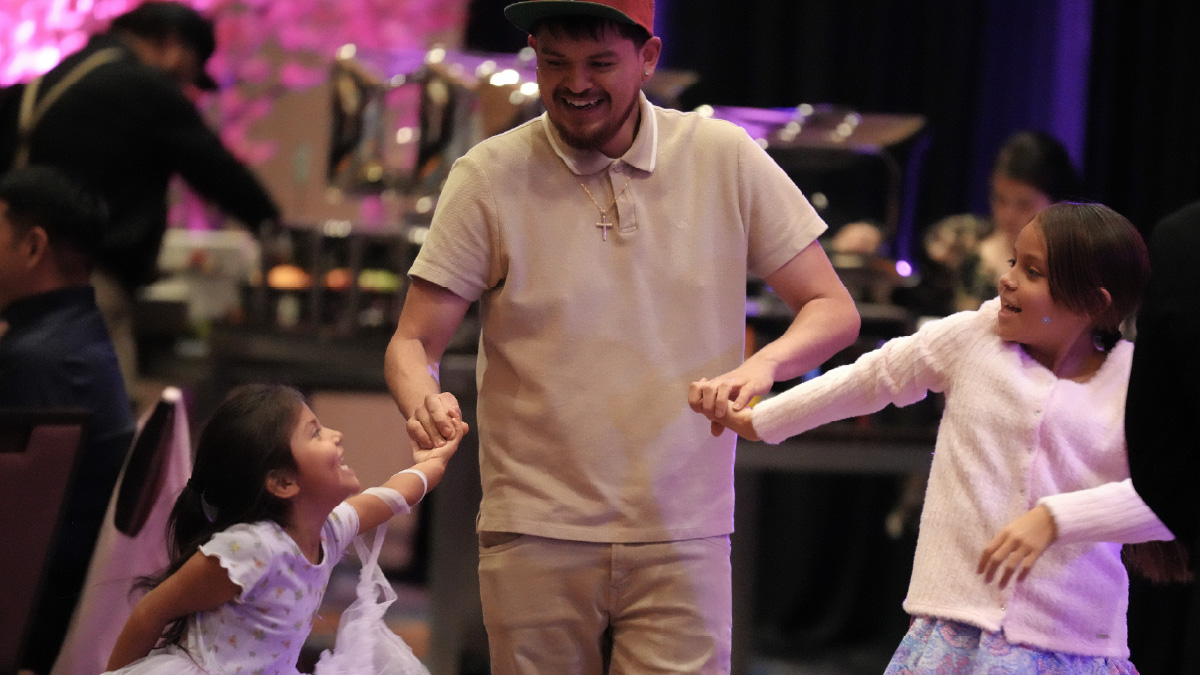
Fathers and daughters came together for an evening of dancing, laughter, and quality time during Muckleshoot’s first Father-Daughter Dance, held on National Daughters Day at the Muckleshoot Event Center.

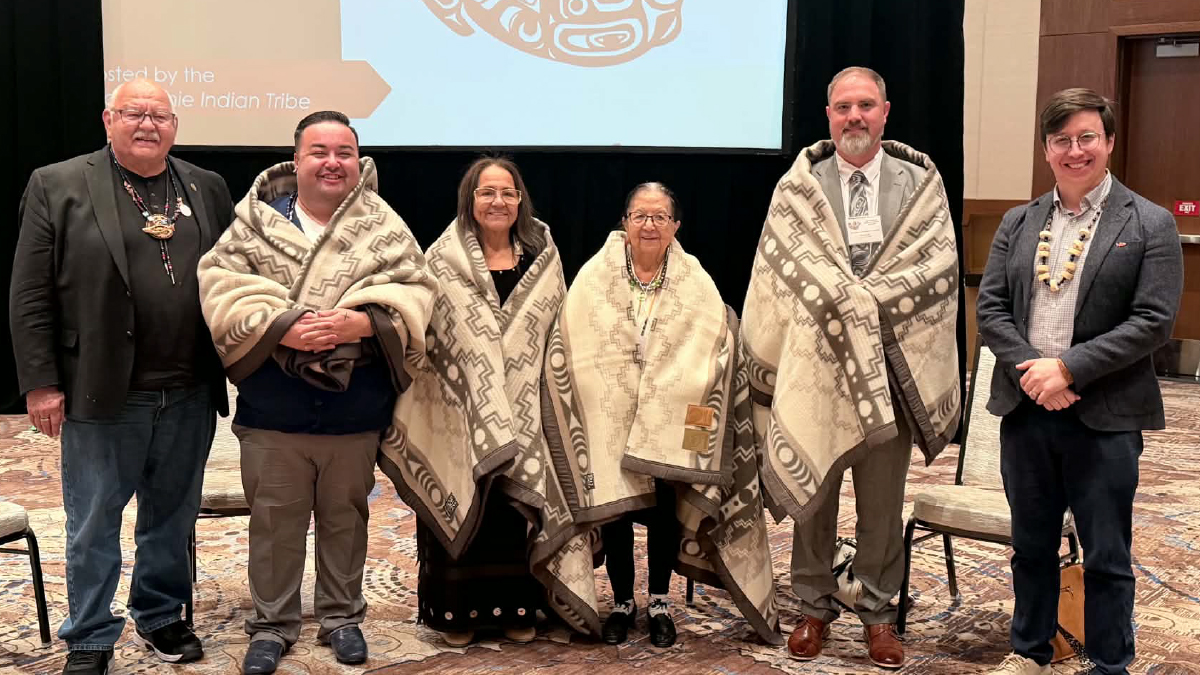
Tribal and state leaders from across Washington gathered Oct. 12-14 at Snoqualmie Casino & Hotel for the 37th Annual Centennial Accord Meeting, hosted by the Snoqualmie Indian Tribe.
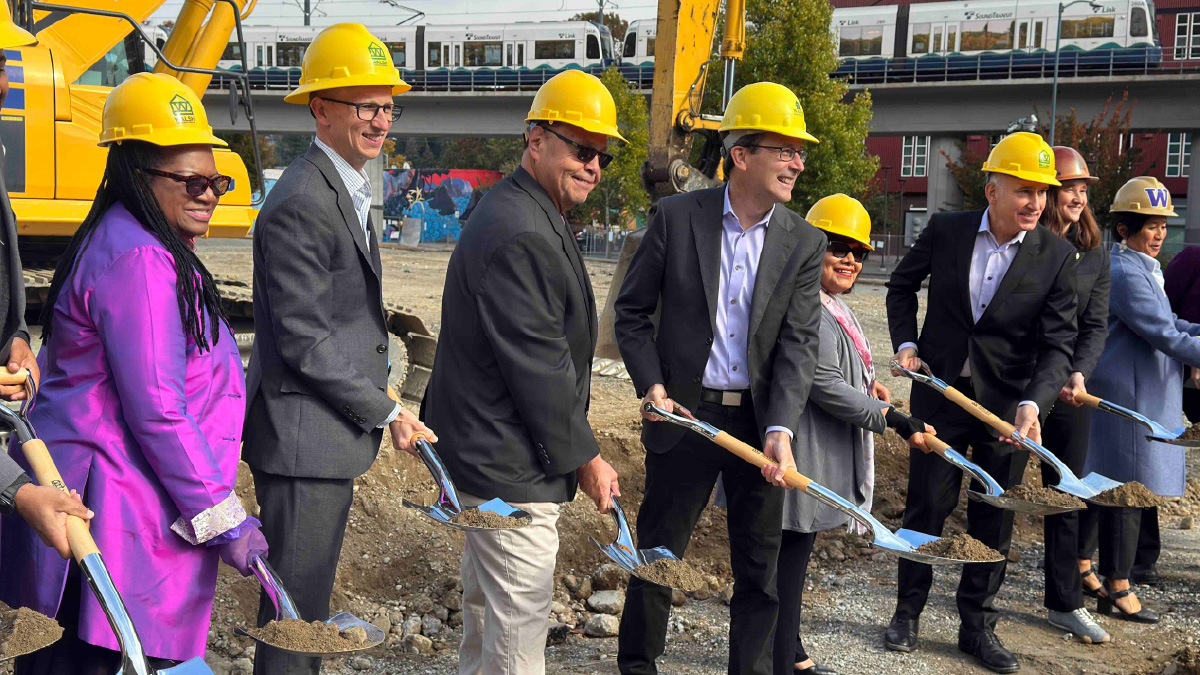
Muckleshoot Tribal Vice Chairman John Daniels Jr. joined community members, project partners, and local leaders Oct. 15 in Seattle for the groundbreaking of Rainier Rising Early Learning Center, and the Mount Baker Redevelopment.

"[Columbus'] very own words defending and justifying his rule of cruelty and its root economy directly based in the human trafficking of young Indigenous children and girls… even in his own time, his acts were seen as evil and heinous..."
The Muckleshoot Messenger is a monthly Tribal publication. Tribal community members and Tribal employees are welcome to submit items to the newspaper such as announcements, birth news, birthday shoutouts, community highlights, and more. We want to hear from you!

Please direct Media Inquiries to Muckleshoot Intergovernmental Affairs.
Official Government Website for the Muckleshoot Indian Tribe
© Muckleshoot Indian Tribe 2026


